Second edition of Yellow Matter available now!
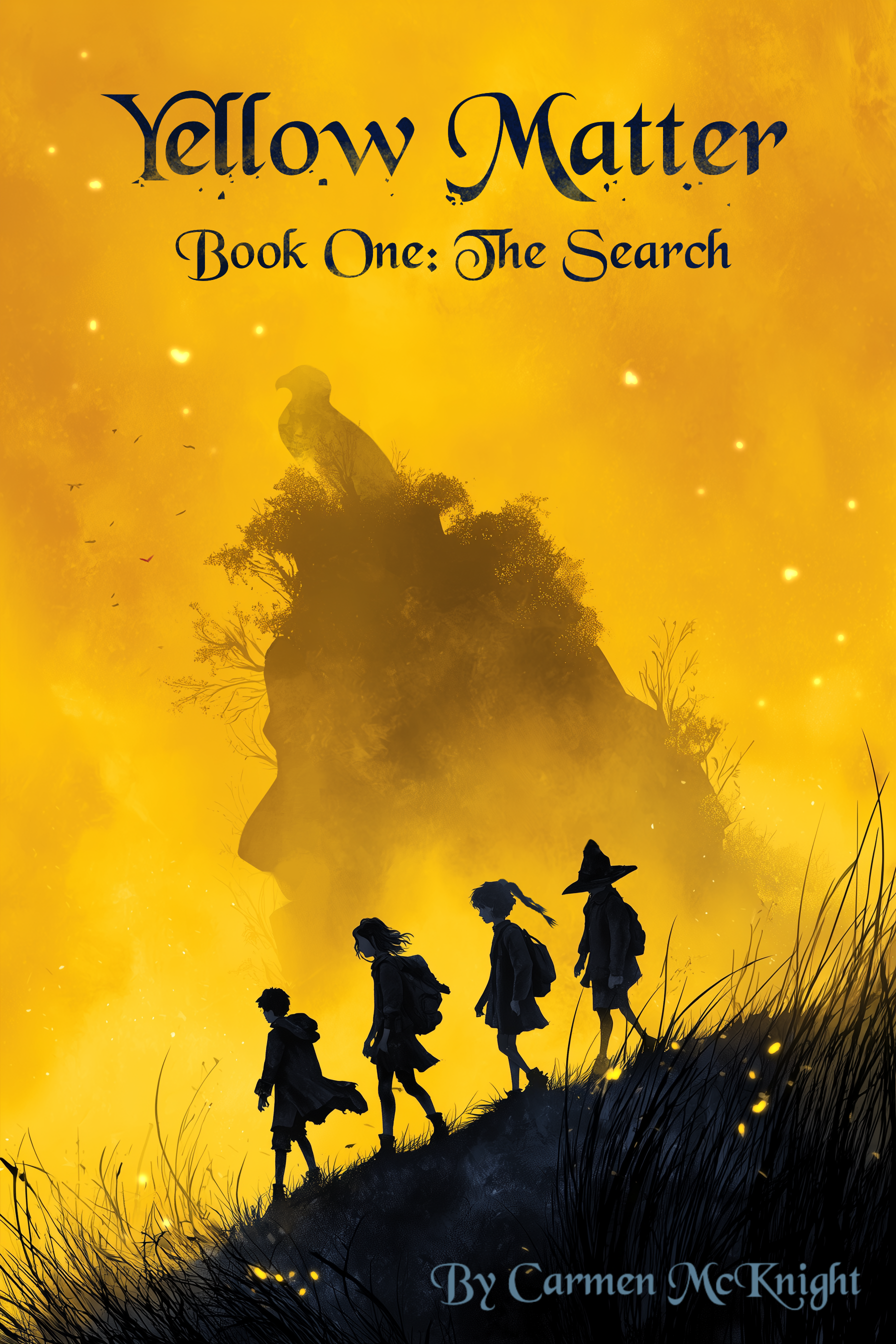
https://www.smashwords.com/books/view/1480101
https://books2read.com/u/m06koy
Set in 1800s Romania, this richly imagined tale blends ancient lore with the raw beauty of a forgotten world—a world still guarded by wonder, faith, and quiet power.
In a village hidden from time, four unlikely friends—Damian, Rue, Alex, and Adina—must rise against a spreading darkness known only as Yellow Matter, a force bent on unraveling the threads of every universe. As the balance teeters between light and decay, the children must confront prophecy, sacrifice, and the haunting truth of what it means to protect the good.
What if the end of all things began in a village no one remembered?
Sample
Chapter 1
The one who roams
Your life to steal,
It is too well concealed.
The Transylvanian Carpathian Mountains-1981
The creature swept over the forest like a sorrowful yellow mist and disappeared as quickly as it appeared. One could doubt what it saw if asked to describe it.
The Hobița-Grădiște-(pronounced-Hobitska-Gradishta) village, divided into three regions: the Northerners, Southerners, and Centrals, was a prominent and usually happy place, tucked snugly at the base of the Carpathian Mountains. A lovely green meadow separated the village from the Five Weeping Towers Lake*, with waters smooth as a mirror. Beyond the lake stood the Dragos Castle, an ancient and forgotten ruin now rumored to host only old ghosts. Behind the castle, a massive forest filled with dead and twisted trees known to everyone as the Dark Death Forest* stood grimly. Yellow Matter’s first newborn drew its first breath there, and since vegetation never survived inside, no one dared enter its belly.
As not to cause petty squabbles and wasted bickering, the regions in the village were equal in size and beauty. If one lacked cunning, like the Southerners, one made up for it with knowledge of plants, herbs, and roots. If another region, like the Northerners, possessed a healthy dose of cleverness and skill, they fell short regarding compassion. As for the Centrals, like a middle child who felt stuck between two more excellent versions of themselves, they felt ignored and outperformed, creating unnecessary work by causing trouble and trying to enforce rules over everyone else.
The houses in Hobita-Gradiste, single-story, small but well taken care of, were lined up on each side of the only road going through. Their stucco was white, and the only distinguishable element was their doors. Its people were simple folks who loved to keep busy and well-fed while using any small opportunity to celebrate life, often by creating many festivals.
The Northerners loved the task of door engraving, and some might say their craftsmanship had a magical touch. Most doors displayed a mix of carved intricacy in walnut wood, linden wood, and European beach wood. The more decadent a household, the heavier and richer elements their doors possessed, like solid metals, bronze nail heads, daggers, and timber, seen throughout the village but predominantly in the North. Above all, the door’s artwork gave the houses a character fitting to the family’s soul living inside, showing the history of that particular family line. A few had intricate family seals welded on to attest to the family’s authenticity. Other doors were more straightforward in style and nature but seemed just as important. And then there were the poor quality doors, two to be precise, made of old wood planks, crookedly holding onto their frames, allowing too much wind to breeze through those uneven cracks at night.
It was common knowledge that the Centrals made beautiful garden accessories such as flags, scarecrows, and bird baths, with a touch of mischievousness on every piece created. Since that was their only skill and work wasn’t enough to keep them occupied, boredom inflicted them often. As an escape, they had time to bicker and come up with all sorts of unnecessary and, at times, down-right ridiculous rules no one paid attention to.
But the pride and joy of every home lay in the gardens behind each house, and the Southerners had the magic touch. Their backyards thrived with herbs, vegetables, legumes, and fruits, soon to become tinctures, teas, ointments, and delicious meals. These gardens provided the families with enough food to nourish them year-round. But the healing magic touch gave the Southerners a heightened level of respect.
Tall haystacks stood stately in the green meadows, waiting to be picked and brought inside barns as livestock food. These haystacks were often messed with by the Centrals’ children of all ages, who jumped on top or hid inside, ran around playing hide-and-seek or such beautiful games. In addition, the Central usually frightens the peacefully grazing sheep, goats, and cows, giggling with mischievousness afterward.
From a glance, the village gave the impression of enchantment; however, every man in their right mind knew that to be impossible. Except for the peculiar Lampost, which the locals called “Lumina veche,” all seemed normal. Every soul born and raised in Romania knew “lumina veche” meant “old light.” Or so they thought. Any outsider who dared to come close to the village’s periphery was met with an icy fog that made men with nervous dispositions swallow hard and hurry away. Only the curious minds with a bit of the daredevil in their veins would venture closer, but the foul smell soon to meet their nostrils would bring along hesitation of advancement. If that didn’t scare them away, the slimy feel on one’s neck as if hosting a giant snake would bring along a frightful apprehension, while the most horrid shrill that always followed nearly froze anyone into place with hypnotic power. After such welcoming sights, one would vow never to set foot in these parts. Yet, to the locals, this little village was their imaginable sublimity, with more hidden escape routes than the apparent main road. Its modesty was invaded only by the church, which towered like a proud tzar adorned in unique murals inspired by Byzantine art. Others argued that it looked closer to a giant gnome with a pointy yet slightly slouched hat. The artist who painted the murals with rich earthly pigments of blues, reds, and gold was long gone, yet its presence remained alive in the stories passed around. Compared to the towering tzar, all the homes gave the impression of servants waiting on their master’s command.
Standing next to the Lampost was a wooden sign displaying the distance to the closest village, Sarmizegetusa, some 100 acres away. Laying in ruins, Sarmizegetusa was a reminder of the Roman outdoor amphitheaters and such glory days. Some days, the Lampost wept sadly, while other days, it giggled away happily. With every new birth, its light shone brightest. Folk would gather around it with the new babe, and the Lampost would decide what gift to pass along to the latest member of the village.
But today, the post began to weep as rivers of rats scurried the opposite ways of the Dark Death Forest.
A book of poems that opens a window into the suffering Lyme disease brings along.
Sample:
Lyme disease suffering prayer
We are the hosts of utterly frightful monsters
Who hurt and hurt and spread with rapid glee
Too small to see, too tough to kill, oh me!
And here and now, our limited existence,
Must be the grounds for such rebellious resistance?
We cry and hurt and hurt with such persistence.
But doctors stare and give us no assistance,
And all we want is our frail existence
Be void of pain but full of sheer emittance.
Of health and joy but not of coexistence.
For my poor, weak defense system
Must be repaired to form a whole existence.
My God, how can such a lack of balance
Exist in tissues? Brain? Heart? What a challenge?
To stay ahead of an enemy within is but a strong talent.
Bring me a stew this very day, I say.
To keep this nasty weakness at bay
And God? When will my weight be regained?
Why are we hunted from within, asks us?
When will these monsters be unmasked?
A cure is all I ask today.
I’m not alone in this. I say
For such dark monsters, all our bodies decay
And we need hope, for that I’ll surely pray.
 Journey